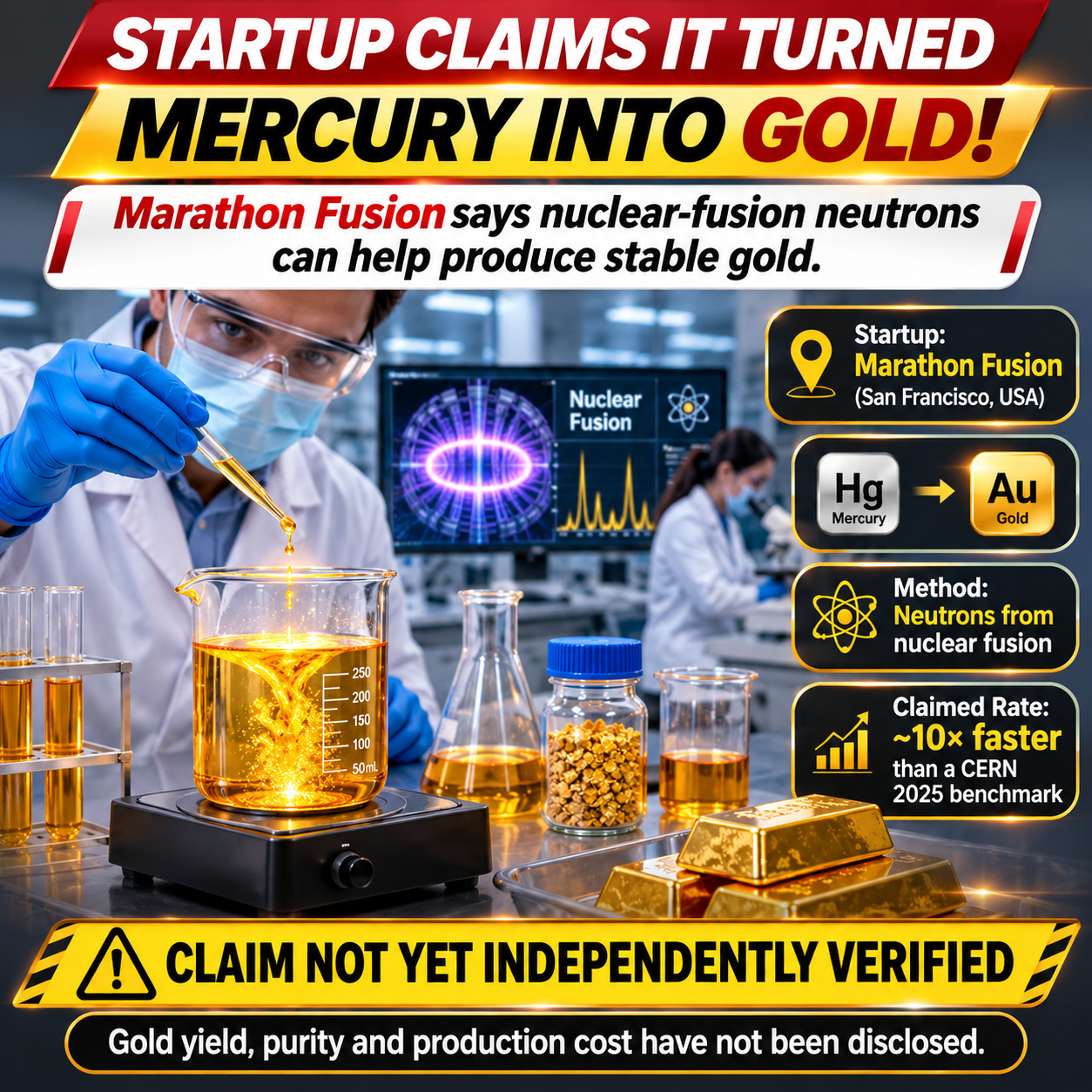
A fascinating development in the world of nuclear science is attracting global attention. Marathon Fusion, a San Francisco-based American startup, has claimed that it has successfully converted mercury into stable gold using nuclear fusion technology. This announcement has sparked discussions about the future of science, gold production, and advanced energy technology. 🌍
🔬 How Does the Process Work?
The company’s proposed technology uses high-energy neutrons generated through nuclear fusion reactions. These neutrons interact with mercury atoms, changing their atomic nuclei through a process known as nuclear transmutation.
According to the company’s explanation, mercury-198 can be converted into mercury-197, which subsequently decays into stable gold-197.
⚛️ What Makes This Discovery Interesting?
Traditionally, gold is obtained through mining and refining. However, nuclear transmutation offers a scientific method of changing one element into another by modifying its atomic nucleus.
The company claims that its approach achieved a production rate approximately 10 times higher than a benchmark associated with CERN’s 2025 experiments.
🏆 Can This Change the Gold Industry?
If the technology can eventually be developed commercially, it could create new possibilities for producing valuable materials through advanced nuclear technology.
However, several major challenges remain, including radioactive byproducts, material purification, production costs, reactor development, and large-scale manufacturing.
📊 Is Lab-Made Gold Ready for the Market?
Not yet! Marathon Fusion has not publicly disclosed the exact quantity of gold produced, its purity, or the actual production cost. Its claims have also not been independently verified.
The company’s earlier projections about producing gold through future fusion power plants remain theoretical rather than commercially demonstrated results.
🌟 The Future of Science
This development demonstrates how nuclear science continues to explore possibilities that once seemed impossible. Whether this technology becomes commercially useful will depend on further experiments, independent verification, and successful engineering.